Friday, October 31, 2014

Shree Siddhivinayak Ganapati Mandir

It is One of the most famous temples of India, located in Prabhadevi, Mumbai, Maharashtra, The Shree Siddhivinayak Ganapati Mandir is a Hindu temple devoted to Lord Ganesh.  Built by Laxman Vithu Patil, the temple welcomes devotees from all around the country and the world to attend religious ceremonies throughout the day and to pay their respects to the Lords. It is currently the richest temple of India.

History of The Temple

Siddhi vinayak Temple was built on a Thursday, 19th November 1801, by a professional contractor and a great devotee of Lord Ganesha, Mr. Laxman Vithu Patil. Mrs. Deubai patil provided the financial support for the construction of this temple.
She could not conceive a child and the idea that led for the construction of the temple was to provide a worship place to other childless women to pray for a child from Lord Ganesha.
Myths and stories that revolve around the temple have led the devotees to believe that Deubai's humble request was accepted by Lord Ganesha.
In the beginning, it was a small structure housing the black stone idol of Shree Siddhivinayak. The temple complex was approximately 2550 Sq. m in area and consisted of two Deepamalas, a rest house and living quarters for the caretaker. In 19th century, Nardulla dug up an adjoining lake to counter the water scarcity in the region.
Later, the lake was filled up and now it constitutes a part of the temple complex. During a road extension project in the year 1952, a Hanuman icon was discovered. A small shrine for the Hanuman icon was built in the temple complex.
By 1952, huge crowds started visiting the temple and by 1965, long queues of devotees were started to be seen outside the temple.


Festivals:
Hundreds of thousands of devotees throng the temple, especially during Angaraki and Sankashti Chaturti days, when there is a continuous stream of visitors for as long as a 24 hour period.

Online Booking& Donation:

Shree Siddhivinayak Ganapati Temple Trust has launched Aashirwad Card on 11th September 2013 at a modest function in the Temple premises. Minister Of State for Law & Judiciary Hon'ble Shri. Uday Samant was the Chief Guest. Guests of Honour, Shri. T.M. Bhasin, CMD Indian Bank and Shri. Suryaprakash Madrecha - CMD Trimax also graced the function. Aashirwad Card is a transferable, Giftable, Refillable Multi purpose Pre-Paid Cashless Card. With Aashirwad Card, Devotees will spend minimum time in the Queues and maximum time taking Darshan and blessings of their favorite Shree Siddhivinayak Ganapati.

Devotees will be able to make all the payments they need to make while at the Temple like:

-:Abhishek / Pooja Booking
-:Darshan Payment
-:Donation to the Temple Trust
-:Prasad
and make the best of their time while at the Temple .

The Aashirwad Card can be used by all members of a family and their friends as well since it is Transferable. They can gift it too.
Aashirwad cards are available in the Temple premises against a donation of Rs. 51/- only  and can be  loaded or recharged at the Temple.  Minimum of Rs. 100/- up to a maximum of Rs. 5,000/- in increments of Rs. 100/-  will be the denominations.
The Aashirwad card uses the proven and dependable RF technology with the chip from Phillips. Guaranteed for a million operations, these will last the Devotees a lifetime.

How To Reach?
By Air:
 Chatrapati Shivaji International Airport, in Mumbai is an International airport and it has flight connectivity from all over the world.
By Train:
Mumbai Railway Station is well connected from all cities in India.
By Road:
Board a local that will take you here, or hire an auto or taxi

Map


View Larger Map

Thursday, October 30, 2014

Parumala Church in Kerala

Parumala is a small stretch of land on the shores of the river “Pampa”. In the days of old, many Brahmin families were living on this island which has an area of about 4 square miles. For various reasons, in course of time these families left the place. However, as relics, we can still see the broken down basements of buildings, disused ponds etc. with the departure of the Brahmins, the place became almost wild, desolate area.

Old Church

Parumal Church is named after the great Saint, Saint Gregorious Geevarghese also known as Parumala Thirumeni. This church is at Mannar in Kerala and is a parish church of the Malankara Orthodox Syrian Church. Parumal church is the tomb church of Saint Gregorious Geevarghese.
It was in 1947 that Mar Gregorious was blessed and declared a saint by the then Catholicos of the church. The present church could accommodate about 2000 believers. It is in a circular design with a diameter of 39 meters. The church is believed to have great powers and many believers come from all parts to pray at this divine church.

New Church

How To Reach?

Map


View Larger Map

Tuesday, October 28, 2014

Sé Cathedral at Old Goa

This is one among the largest church in India and is located in Goa. This Cathedral is dedicated to Catherine of Alexandria. This church was built to honor the victory of Portuguese under a Muslim army, which led to the capture of the city of Goa.
Since this victory accidentally happened on the feast of St. Catherine, the cathedral was dedicated to her. The actual construction began in 1562 and was completed in 1619 and sacred in 1640. The church is 181 feet in breath and 250m in length.
On account of the rich tone of the bell in the Cathedral, it is known as the “Golden Bell”. It is known to be one of the best bells in the world and the largest in Goa. On the main Altar, there are several old paintings and it is dedicated to Catherine of Alexandria. On the right, there is a chapel, where it is believed that a vision of Christ is said to have appeared in 1919. This chapel is also known as Cross of Miracles.


How to reach?

Map


View Larger Map

Monday, October 27, 2014

Basilica Of Bom Jesus

The Basilica of Bom Jesus is Located in Old Goa, India. It is a UNESCO World Heritage Site. The foundation stone was laid on 24th November 1594, and completed on 15th May 1605. It was raised to the status of a minor Basilica in 1946 and is considered to be one of the best examples of Baroque architecture in Goa. The church is called “Bom Jesus” meaning ‘good Jesus’ or ‘infant Jesus’ to whom it is dedicated. The Basilica holds the mortal remains of St. Francis Xavier in Goa.


St. Xavier's quest took him to Malacca and then the Molucca Islands, Amboyna, Ternate, Baranura, and the island of Mindanao, Philippines. He met a Japanese man called Anger and baptized him in Goa. He arrived in Japan in 1549 and began preaching. After three years, he returned to Goa. Thereafter, St. Xavier left for China where he fell ill en- route. With his aggravated condition, he was offloaded at Sancian where a make shift hut had been built to shelter him. Here, he breathed his last.
It is said that the following year when the body of the saint was being transferred to Goa as per his wishes, the people were shocked to find his body fresh as ever. This was claimed to be a miracle and his body was preserved in an air tight coffin made of glass and placed inside a silver casket. Every year thousands of devotees visit the Basilica of Bom Jesus on 2nd December to see the mortal remains of the saint that is displayed publicly. Now, the practice has been stopped to prevent the body from deterioration.

The Basilica of Bom Jesus is one of the richest churches in Goa and also all over India and a renowned pilgrimage site of Christians. It is covered with marble flooring and inlaid with precious stones. Except for the elaborately gilded altars, the interior of the church is simple. The church houses paintings of St. Francis Xavier. In fact the Tomb of St. Francis Xavier (1696) was the gift of the last of the Medicis, Cosimo III, the Grand Duke of Tuscany. Carved by a 17th century Florentine sculptor, named Giovanni Batista Foggini, it took 10 years to complete. The casket containing his body is made of silver. The holy relics of the saint are displayed every 10 years on the anniversary of his death.


How to reach?

Map


View Larger Map

Saturday, October 25, 2014

Mahanandi Temple

Mahanandi is a village located east of the Nallamala Hills near Nandyal, Kurnool District, Andhra Pradesh, India. It is a delightful village surrounded by thick forests. Within 15 km of Mahanandi, there are nine Nandi shrines known as Nava nandulu. Mahanandi is one of the Nava Nandis. The Mahanandiswara Swamy Temple, an important shrine, is located here. This ancient temple is over 1,500 years old . It is repaired and rebuilt several times.

Nine Nandi's present in Nallmala Hill Region is:

1) Mahanandi
2) Prathama Nandi [near Nandyal Railway Station]
3) Naga Nandi [In Nandyal Anjaneya Temple]
4) Soma Nandi [In Atmakur town]
5) Surya Nandi [6 miles west of Mahanandi]
6) Krishna Nandi or Vishnu Nandi [2 miles from Mahanandi]
7) Vinayaka Nandi [Present in north-west of Mahanandi temple premisis]
8) Shiva Nandi [13kms away from Nandyal town]
9) Garuda Nandi [Present in western side of Mahanandi temple]

Festivals:
A festival is held here annually during February and March to celebrate Maha Shivaratri, the Great Night of Shiva.

Temple Attractions:

The shrine or deity of Lord Shiva present in this sacred temple belongs to 7th century. The basic temple structure was constructed by Chalukyas (7th century) and was later enhanced by Nanda Dynasty (10th century) and Vijayanagara Kings (15th century).
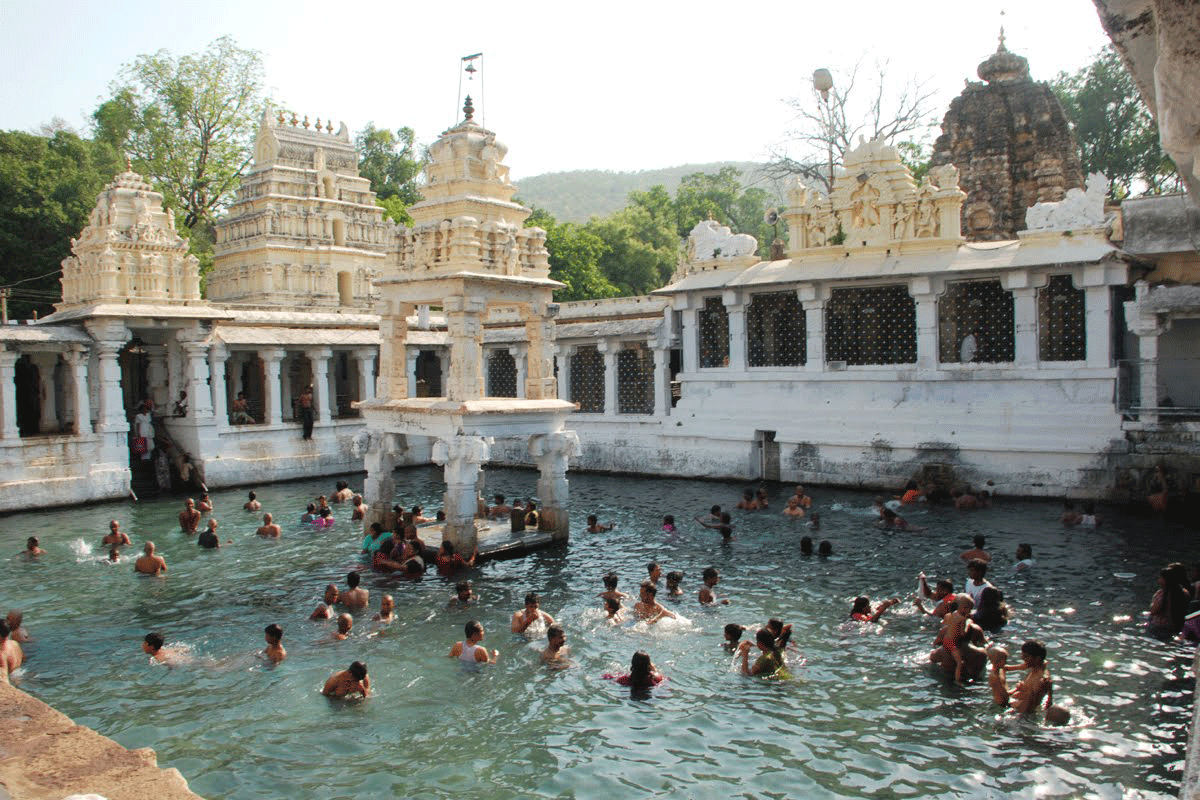
Devotees can take holy dip at Mahanandi temple Pushkarni or Koneru in which there are Pancha Lingams of which the centre one is called Varuna Lingam. Irrespective of the seasons, water in the Pushkarni [Koneru] is at same constant five feet flow.
It is said that the main water source is originated below the inner Swayambhu Linga at the Garbhagruha and the pilgrims can touch the Shiva Lingam to perform puja and also take the holy water as Thirtham.
The outgoing water of Mahanandi temple is used for irrigiation of fertile lands in the surrounding areas of the temple. One of the world's biggest man-made Nandi of 15 ft. x 27 ft. is present near the Mahanandi temple.
The main Gopuram of this temple resembles Badami Chalukyan style architecture where as other temple structures resemble the Vijayanagara style.


Koneru(Pushkarini) at Mahanandi


How to reach?
By Air:
The nearest airport is at Hyderabad i.e about 288kms from Kurnool.
By Train:
It can be well-reached by train with the nearest railway station at Nandyal.
By Bus:
To reach Mahanandi there are good bus facilities from the nearest villages.  The small temple town is also connected by rail and road from the town of Kurnool.

Map


View Larger Map

Padmanabhaswamy Temple

The Padmanabhaswamy temple is located in the centre of Thiruvananthapuram, the capital of Kerala.

History of Temple

Divakara Muni was a great Vishnu Bhaktha. While at ‘Aanarthadesa’, he performed deep tapas. One day Maha Vishnu appeared before the sage as a lovely child. The charming child attracted the attention of the sage. He requested the God-child to stay with him. The child made his stay conditional. Accordingly, the Sanyasi should treat him with respect. On failing to do so, he would vanish at once. This was accepted and the child stayed with him. The hermit gave him great care and tolerated the childish pranks. One day, when the sanyasi was in deep meditation at his prayers, the chills took the ‘salagram’ which the sanyasi was using for worship and put it into his mouth and made such a nuisance of himself that Divakara Mini was greatly angered and could tolerate it no further. He thereupon chastised the child. In accordance with the earlier agreement, immediately the child ran away and disappeared from the spot. While going he said, “If you wish to see me again, you will find me again in Ananthankaadu”. It was only then that Divakara Muni realized who his erstwhile child guest had been. The hermit was stricken with inconsolable grief and for many days followed what, he believed was the route taken by the child foregoing food, rest and sleep in the process.
Finally he reached a wooded area near the sea coast, caught a glimpse of the child disappearing into a huge ‘Ilappa’ tree. Immediately the tree fell into the ground and it assumed the form of Sree Maha Vishnu. The divine form had its head at ‘Thiruvallam’(a place about 3 miles from East Fort at where the Temple of Sree Padmanabha Swamy is located) and its feet at ‘Trippapur’ (5 miles away towards the north). Overawed by the majesty and the size of the divine form, which manifested before him, the Sanyasi prayed to the Lord to condense Himself in size so that he could behold Him. There upon the image of the Lord shrank to a size, three times the length of the Sanyasy’s Yoga Dand. His prayers had been granted. He immediately offered a raw mango in a coconut shell(still this offering continues). The Lord ordained that, poojas to Him should be conducted by Tulu Brahmins. To this day half the number of poojaris(priests) in this Temple represent Tulu region.
The principal deity Padmanabha is enshrined in the "Anantha-Sayanam" posture the eternal yogic sleep on the serpent Anantha. The titular Maharaja of Travancore Moolam Thirunal Rama Varma is the trustee of the temple as Sree Padmanabhadasa, the "Servant of Lord Padmanabha". In line with the Temple Entry Proclamation, only those who profess the Hindu faith are permitted entry to the temple. Devotees have to strictly follow the dress code.


Festivals:

Chingam 1st

Malayalam New Year Day attracts many devotees here.

Vinayaka Chathurthi

This event comes on the Chathurthi tithi on Karuthapaksham(New Moon) of Chingam. Special offerings and deeparadhana are conducted for the Ganesh idol in the Sree Rama Shrine. ‘Chirappu’ is observed for the Agrashala Ganapathi. The Valiya Thampuran (eldest male member of the royal family) worships here only on this day and witnesses the deeparadhana.

Thiruvonam

This is one among the most major celebrations of this Temple by virtue of the fact that it is the Thirunal (Birthday) of Sree Padmanabhaswamy. The Temple celebrates this day in the manner laid down long ago. Of special note is the submission of the Onavillu to the Deities. It has a tradition of centuries behind it.

Ashtami Rohini

Sree Krishnaswamy's birth day is celebrated all over India in the month of Chingam when the asterism Rohini and the thithi Ashtami coincide. In this Temple special decorations and offerings mark this day. The Temple opens early in the noon by 2 pm. At 2.30pm abhishekam of milk is performed to Sree Krishna. On this day an exquisitely decorated ivory cradle is placed on the Abhisravana Mandapam and number of images of Lord Krishna are kept inside for the devotees to view. It is believed that if prayer is offered to them by childless couples, they will be blessed with infants.

Navarathri Pooja

In connection with the Navarathri festival Sree Saraswathi Amman is brought from Padmanabhapuram Palace in Kanyakumari District and worshipped traditionally in the Navarathri Mandapam at the Valiya Kottaram complex. Huge crowds throng for darshan. Sree Kumaraswamy from Kumarakovil and Sree Muthuttee Nanga from Suchindram also accompany Her in grand procession.

Valiya Ganapathi Homam

This is carried out for twelve days starting two days before the commencement of the Navarathri Festival, by the Tharananalloor Namboodiripads who are Tantries of the Temple.

Alpasi Ulsavam

Sree Padmanabhaswamy Temple celebrates bi-annual festivals in the months of Thulam (Alppasi) and Meenam(Painkuni). A function is conducted for according formal sanction to conduct the Ulsavam(festival). This is known as Anujna. Other functions include Mannuneeru Koral, Mula Pooja, Kalasam, etc. The festival starts with Kodiyettu(flag hoisting) at Sree Padmanabhaswamy’s gold and Sree Krishnaswamy’s silver flag poles. The festival is of ten days duration culminating in the spectacular Palliveta and Arat processions on the 9th and 10th days respectively. Kalasams also known as Ulsava Kalasams take place in addition to the routine rituals. Special Sreebalies (Processions) are conducted twice a day, in the evening 4.30 pm and at night 8.30pm.Exception is there on the first day when there is only night Sreebali.
Once during the reign of Sree Anizhom Thirunal Marthanda Varma, an elephant ran amock. Since then, the practice of using elephants to carry the idols in the procession was given up and Vahanas (vehicles) carried on the shoulder by a number of priests came into vogue. Six different kinds of beautiful conveyances are used for these processions. They are the Simhasana Vahanam(Throne), Anantha Vahanam(Serpant), Kamala Vahanam(Lotus), Pallakku Vahanam(Palanquin), Garuda Vahanam(Garuda) and Indra Vahanam(Gopuram). Of these the Pallakku and Garuda Vahanas are repeated twice and four times respectively. The Garuda Vahanam is considered as the favorite conveyance of the Lord. The different days on which the various Vahanams are taken out for the procession are as follows.

1st day of Utsavam Simhasana Vahanam
2nd day of Utsavam Anantha Vahanam
3rd day of Utsavam Kamala Vahanam
4th day of Utsavam Pallakku Vahanam
5th day of Utsavam Garuda Vahanam
6th day of Utsavam Indra Vahanam
7th day of Utsavam Pallakku Vahanam
8th day of Utsavam Garuda Vahanam
9th day of Utsavam Garuda Vahanam
10th day of Utsavam Garuda Vahanam

Mandala Chirappu

The celebration for the Sastha begins on the first of Vrischikam. Mandalachirappu falls on the 41st day.

Swargavathil Ekadasi

This is an auspicious day for the devotees of Maha Vishnu. On this day people throng the Temple. Special poojas, offerings and night Siveli take place. The Temple remains open for longer duration.

Bhadradeepam

Bhadradeepam is observed on the summer and winter solstices. On these day Bhadradeepappura is opened and special poojas are made.

Kalabham

This is conducted for seven days commencing from the last six days of Dhanu and Midhunam. The ablution with sandal paste on the idols is the highlight of the function.

Makara Sreebali

A night Sreebali observed on winter solstice (Utharayanam).

Sivarathri

This is a day celebrated all over India as important for Sree Parameswara. On this day special Abhishekam is done to the Shiva residing in the Sanctum.

Painkuni Utsavam

All the rituals and functions which take place for this Utsavam are same as for Alpasi Festival, the difference being the asterism. While prominence is given to the star Thiruvonam under which alone the Arat takes place for Alpasi, for Painkuni the emphasis is on the day of Kodiyettu (flag hoisting) on which the asterism is Rohini. In connection with this festival the massive figures of Pandavas are erected at the Eastern entrance of the Temple.

Sree Rama Navami

Special poojas are performed on this day for Sree Rama.

Vishu

Vishu is an extremely auspicious day for Malayalees. Vishukani is arranged inside the sanctum of all shrines in this Temple complex. The Temple opens an hour earlier for Vishukkani Darshanam.

Karkataka Sreebali

On the first day of the Malayalam month Karkkitakam solstice (Dakshinayanam) the Karkkitaka Sreebali takes place. Its procedure is same as the Makara Sreebali.
Sree Veda Vyasa Jayanthi
Sree VedaVyasa Jayanthi is celebrated on the full moon day of Karkkitakam in honour of the great sage Vyasa who resides in his separate shrine. Sree Veda Vyasa consecrations are rare.

Niraputhari

On the day of Niraputhari sheaves of grain are ceremoniously brought to the Temple. The chief priest removes some sheaves from the bundle after performing pooja to the same and takes them inside the sanctum of Sree Padmanabha Swamy and submits them. Some sheaves are spread out on the Ottakkal Mandapam. This procedure takes place in all the other shrines of this Temple complex.

Murajapam

The very term reveals its meaning. ‘Mura’ means turn and ‘Japam’ means chanting. This prayer lays tremendous stress on the chanting of Vedas and the Vishnu Sahasranamam( thousand names of Maha Vishnu). It is celebrated once in six years. It comprises 56 days of Veda chanting, Sahasranama Japam and rituals.

Lakshadeepam


Lakshadeepam literally translates as one lakh lamps. The entire Temple is adorned with lamps. The Sreebali (Procession) conducted with illumination on the concluding day of Murajapam is known as Lakshadeepam. The maiden Lakshadeepam was celebrated on the 1st of Makaram 925 ME / 14th or 15th of January 1750 AD. The festival was conducted with much pomp and fanfare, in the grandest manner possible by King Marthanda Varma. The latest Lakshadeepam was celebrated in 2008. The next one is due in 2014. It still continues as an immensely grand festival and visual magnitude attracting staggering numbers to the doors of this great Temple.

Darshan Timings:

Morning

03.30 am to 04.45 am (Nirmalya Darshanam)
06.30 am to 07.00 am
08.30 am to 10.00 am
10.30 am to 11.10 am
11.45 am to 12.00 Noon

Evening

05.00 pm to 06.15 pm
06.45 pm to 07.20 pm

The above-indicated time schedule is subject to changes during festivals and other special occasions. During the festival occasions the darshan time is reduced in order to performing the special poojas.

How To Reach?

Map


View Larger Map

Murudeshwar Temple

Murudeshwar is another name of the Hindu god Lord Shiva. Murudeshwar is located in Bhatkal Taluk ,Karnataka, India. It is Famous for the world's second-tallest Shiva statue, the town lies on the coast of the Arabian Sea and is also famous for the Murudeshwar Temple.

History of Murudeshwar

Ravana, the asura king of Lanka, wished to have the all powerful Atmalinga of Shiva, so that he can become invincible and immortal by worshipping it. Pleased by his severe penance, Lord Shiva gave him the Atmalinga but warned him not to place it on the ground till he reached his destination.
Upset by the thought that Ravana would become more powerful by worshipping the Atmalinga, the Gods devised a plan to take it away from Ravana. The Gods knew that Ravana being a pious devotee of Lord Shiva was punctual in performing the periodical rites everyday.
As Ravana approached Gokarna, Lord Vishnu blotted the sun with his Sudharshana Chakra. Thinking that it was evening, Ravana was in two minds whether to put down the Atmalinga or skip his evening rites. Just then, Lord Ganesh came to that place in the guise of a brahmin boy. Ravana called the boy and asked him to hold the linga until he completed his evening rites. The boy agreed on the condition that he'd keep the linga down if Ravana didn't return before the boy called out his name thrice. Ravana agreed and went about his rituals, but by then the boy called out his name thrice and place the Atmalinga on the earth, and it got firmly entrenched in the earth.
When Vishnu withdrew his Sudharshan chakra, Ravana saw bright sunlight and understood that he was tricked by the Gods. He became furious. He came to the Linga and tried to uproot it with all his might. But the idol did not budge even a liitle. The idol's shape now looked like a cow's ear. Hence, the place is known as Gokarna. (Go means Cow and karna means Ear in sanskrit).The crest fallen Ravana was deeply upset and beat the boy on his head. In anger he pulled and threw the case of linga, which fell 23 miles away at Sajjeshwar. He threw the lid to the south 27 miles away at Guneshwara in the form of “Vamdev Linga”. He threw the cloth wrapped to the idol to south, 32 miles away at Kanduka hills on shore of sea. It took the form of “Aghora”at Murudeshwar. The thread winding the idol was flung to south at Dhareshwara, came to known as “Tathpurusha Linga”.
Shiva learnt all this from wind god Vayu. He came on earth along with Parvathi and Ganesha and visited all these five places and worshipped the linga. He declared that these would be his Panchakshetras and those who worshipped lingas at those places would be free from all sins and their wishes would be fulfilled and ultimately reach the abode of Shiva.